
What's Inside
- The Evolution of Nordic Kitchen Architecture
- Criteria for Selection: Defining Authentic Norwegian Design
- 7 Core Principles of Norwegian Kitchen Design
- Scope and Limitations: Adapting Nordic Principles Globally
- The Future of Scandinavian Heritage in Design
The Evolution of Nordic Kitchen Architecture
Norwegian kitchen design begins with climate before it becomes style. That is the point many glossy interpretations miss. The pale cabinet fronts, the quiet lines, the stone surfaces: these are not decorative gestures first. They descend from rooms that had to hold warmth, tolerate darkness, and make local materials work hard through long winters.
In older Nordic interiors, the kitchen sat close to the hearth both practically and symbolically. Architects and builders prioritized thermal mass and local availability, selecting dense stones that could retain heat from traditional hearths before those same material instincts moved into more refined domestic rooms. Soapstone did not enter the kitchen because it looked severe and handsome. It entered because it behaved well around heat, water, and daily labor.
That inheritance still matters in modern interiors, even when the wood is machine-planed and the appliances are hidden behind cabinetry. The best Norwegian kitchens do not merely borrow a silhouette. They carry forward a way of thinking: choose materials that age visibly, organize the room around movement, and let the architecture soften the weather outside.

One workshop note has stayed with Ingrid Voss from examining Scandinavian joinery specifications: raw regional oak intended for indoor cabinetry is commonly kiln-dried for roughly two to three weeks to reach a moisture content of around 6-8%, suitable for interior joinery. That figure is not romantic. It is quiet discipline. A cabinet door that looks simple on the wall may have passed through a highly controlled preparation process before it ever met a hinge.
The shift from purely utilitarian space to design-led environment did not erase this discipline. It made it more visible. A contemporary Norwegian kitchen can now read as architectural furniture, but the old questions remain underneath: Will the surface tolerate heat? Will the joint move without splitting? Will the room still feel calm when the weather turns hard?
For a broader context on the historical evolution of Nordic architectural standards, Nordic public design institutions remain useful starting points. Still, the kitchen is where the theory becomes most unforgiving. A chair may be admired across a room. A worktop gets wet, scratched, heated, and judged every morning.
Criteria for Selection: Defining Authentic Norwegian Design
Authenticity in this field is not a mood board. It is a set of material tests.
Designers establish the baseline by evaluating materials for their patina potential over decades of use. That means they deliberately bypass synthetic finishes that offer immediate showroom perfection but little long-term character. A Norwegian kitchen should not look untouched after ten years. It should look cared for.
Material Longevity Comes First
Generic “Scandi-style” often begins with color: white walls, pale timber, slim black hardware. Authentic Norwegian design begins further down, with the substance of the room. Raw oak, soapstone, untreated metals, and carefully brushed steel make a different promise than laminate imitations. They do not pretend to remain unchanged.
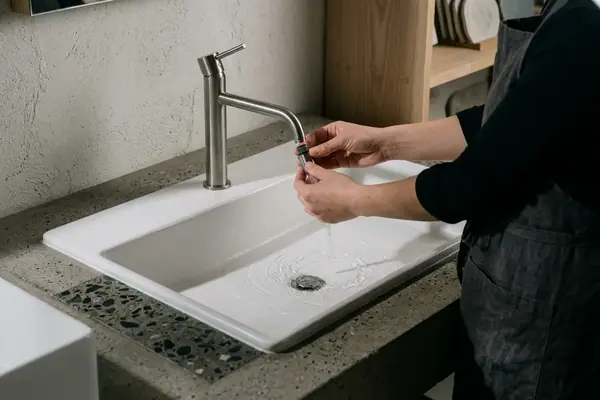
Untreated metals require a precise eye. Stainless steel earns its place not through shine alone but through its chromium oxide layer, which helps the surface resist corrosion while keeping the material visually honest. In a kitchen with strong daylight from one side, even the grain direction of brushed steel fixtures deserves attention. Turn the brushing carelessly, and the sink rail or tap body can flare under light rather than recede into the composition.
Environmental Harmony Is Not Rustic Styling
Norwegian design is often described as natural, but that word can become lazy. Environmental harmony is not a bowl of pinecones on the counter. It is the measured relationship between daylight, timber, stone, air movement, and human reach.
A soapstone counter beside oak cabinetry creates one kind of balance: mineral density against cellular warmth. A pale wall opposite a window creates another: reflected light without glare. These decisions feel modest, yet they decide whether the kitchen supports daily life or merely photographs well.
Critical Insight: Authenticity is found less in the visible palette than in the invisible tolerances: moisture content, joint movement, surface aging, and the way light travels across the room.
Spatial Efficiency Separates Principle from Trend
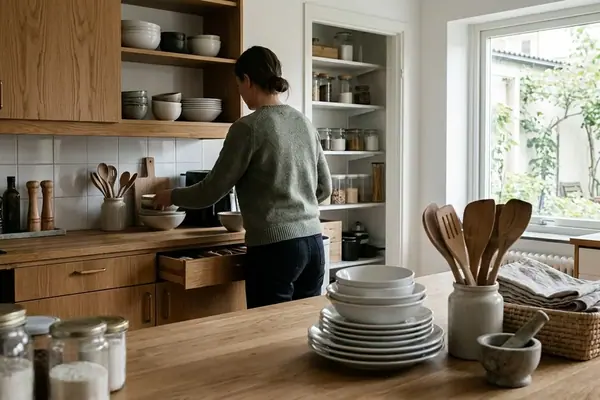
A Norwegian kitchen rarely wastes steps. This does not mean every room must be tiny or monastic. It means circulation should feel inevitable. Storage lands near the hand that needs it. The sink, preparation surface, and cooking zone speak to one another without forcing the body into theatrical movement.
That is where foundational architecture differs from trend. A trend can be copied through finishes. A principle must be rebuilt around the person using the room.
7 Core Principles of Norwegian Kitchen Design
When these principles are codified well, they resist decorative shortcuts. The initial framework often tempts designers toward traditional Nordic color palettes; that approach proves too thin because authentic Norwegian architecture depends more on proportion, material behavior, and light than on whiteness alone.
Seven principles carry the most weight.
1. Uncompromising Material Honesty
Raw oak, soapstone, and untreated metals form the backbone. They should not be disguised as something smoother, newer, or more fashionable. The grain, veining, and slight tonal shifts are not flaws to be edited out. They are the record of the material doing its work.
In practice, this principle affects cost planning. A heavy soapstone worktop needs cabinetry that can receive the load properly. One recurring weak point is MDF core swelling under heavy soapstone countertops due to inadequate edge banding in wet zones. The problem is not the stone. The problem is pretending a wet kitchen edge behaves like a dry furniture panel.
2. Integration of Natural Light
Norwegian interiors developed under limited winter daylight, so the kitchen must catch and distribute light with care. Reflective surfaces help, but only when they remain gentle. A polished glare patch above a preparation area can fatigue the eye faster than a dim corner.
Light-toned timber, honed stone, pale plaster, and satin metal all have roles. The aim is not brightness at any cost. The aim is a usable glow.
3. Ergonomic Spatial Flow
The working triangle still matters, though it should not be treated as a sacred diagram. Sink, cooking surface, and cold storage need a disciplined relationship, but contemporary kitchens also include waste sorting, coffee preparation, charging drawers, and concealed pantry functions.
The Norwegian reading is pragmatic: minimize unnecessary movement without turning the room into a machine. A good kitchen lets two people pass without negotiation. A better one lets one person cook while another quietly makes tea.
4. Tactile Surface Contrast
Contrast does not need to be loud. The most convincing Norwegian kitchens often place a dense, cool surface next to a warm, fibrous one. Soapstone against oak. Brushed steel beside limewashed plaster. A leather pull darkening slowly under the same hand.
Comparisons demonstrate the value of restraint here. High-contrast black-and-white schemes can look crisp on installation day, but tactile contrast tends to deepen rather than date. It asks to be touched, not merely seen.
5. Seasonal Movement Built Into the Detail
Solid timber moves. Norwegian joinery respects this instead of fighting it.
Cabinet details may specify shadow-gap clearances of roughly 3.5 to 4.2 millimeters to accommodate seasonal expansion and contraction of solid timber. That small line of darkness between panels is not only visual refinement. It is mechanical patience.
6. Repairability Over Permanence
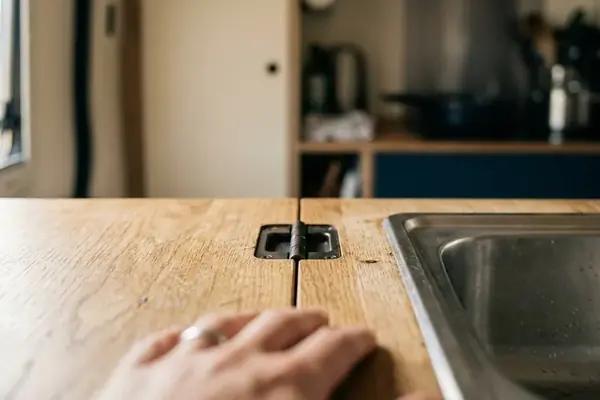
Mechanical fastening systems deserve renewed attention in heavy kitchen fixtures. Screws, plates, and accessible mounting points can look less glamorous in specification notes than permanent chemical adhesives, but they support repair. They allow a future craftsperson to tighten, adjust, remove, and replace.
Modern fabricators are returning to these systems for architectural fixtures because kitchens age through torque as much as through surface wear. Hardware mounting points and hinge plates may be engineered to withstand somewhere around 15 to 22 years of daily torque before requiring structural adjustment. That is a more useful measure of quality than a pristine launch photograph.
7. Visual Restraint With Functional Depth
Norwegian minimalism is not emptiness. It is edited sufficiency. The eye rests because the hard decisions have already been made inside the plan: where appliances disappear, where utensils live, where the heavy pot lands, where the light falls at four in the afternoon.
This is the principle most often copied badly. Remove too much and the kitchen becomes sterile. Hide too much and it becomes irritating. The successful room feels calm because function is close at hand, not because life has been erased.
Material Application Matrix for Norwegian Kitchens| Design Principle | Primary Material | Architectural Application |
|---|---|---|
| Uncompromising Material Honesty | Raw Soapstone | Heat-resistant countertops and integrated sink basins |
| Tactile Surface Contrasts | Oak, brushed steel, and honed stone | Cabinet fronts, fixtures, and preparation surfaces with distinct hand-feel |
| Seasonal Movement Built Into the Detail | Solid regional oak | Shadow gaps, floating panels, and joinery that accepts timber movement |
Scope and Limitations: Adapting Nordic Principles Globally
The philosophy travels better than the literal specification. That distinction matters.
A kitchen in Bergen and a kitchen in Singapore cannot rely on the same timber behavior. Solid, untreated oak cabinetry requires strict indoor climate control to maintain relative humidity roughly between 40% and 55%, which makes it highly unstable for naturally ventilated homes in tropical or coastal zones. This is not a minor caveat. It changes the joinery strategy, the finish schedule, and sometimes the material itself.
Adapting Timber Without Losing the Idea
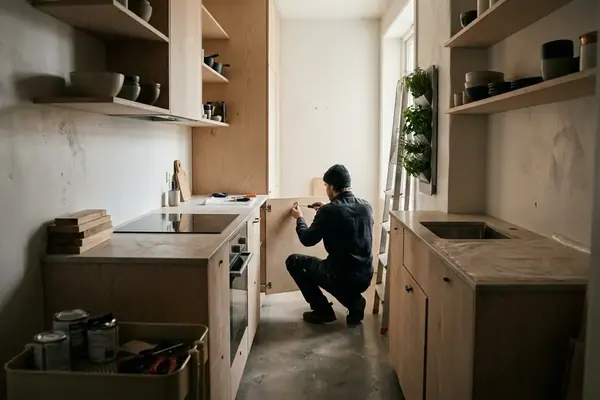
Interior architects working outside Nordic climates often modify traditional joinery with floating tenons and elongated screw slots. These details allow greater material movement without compromising the quiet visual order of the room. The surface can still read as calm. The construction underneath has simply become more climate-aware.
There is no shame in substituting a more stable substrate where the environment demands it, provided the design keeps the original ethic: durable, repairable, tactile, and restrained. The mistake is to cling to untreated solid wood in a room that will punish it every wet season.
Adjusting Light in Bright Climates
Nordic lighting strategies often try to capture soft, scarce light. In regions with abundant, harsh sunlight, the task reverses. The kitchen may need deeper reveals, matte surfaces, filtered glazing, or warmer interior tones to prevent the room from becoming bleached and brittle.
Brushed steel again provides a useful example. In a soft northern room, a lightly reflective fixture can lift the composition. Under fierce direct sun, the same fixture may need a different grain direction or finish so it does not throw hard streaks across the worktop.
Risk Factor: The most common global adaptation error is copying Nordic paleness without recalibrating humidity, glare, and material expansion.
Maintaining Philosophy While Changing Materials
One can preserve Norwegian design principles with altered materials if the hierarchy remains intact. Longevity comes before novelty. Repairability comes before seamlessness. Spatial flow comes before display.
That hierarchy is what keeps adaptation from becoming imitation.
The Future of Scandinavian Heritage in Design
Norwegian kitchen design feels newly relevant because contemporary homes carry too much noise. Screens, small appliances, open shelving, visible packaging, and restless material changes all compete for attention. A restrained kitchen offers more than aesthetic relief. It gives the household a durable operating system for daily life.
The future of this heritage will not depend on making every kitchen look like a fjord-side cabin. It will depend on whether designers keep investing in quality materials and legible construction. A cabinet that can be adjusted after years of use has a different moral character from one that must be discarded when a hidden adhesive fails.
Why Minimalism Still Holds
Norwegian minimalism works because it is not afraid of use. It allows a nick in oak, a darkened soapstone edge, a softened metal pull. These marks do not diminish the room when the underlying choices are sound.
That is the quiet advantage of patina-led design. It does not require the homeowner to freeze the kitchen in its first week of life.
Where Investment Matters Most
Spend on the parts that take punishment: hinges, drawer runners, edge details, worktops, sink zones, and the cabinetry structure beneath stone. Save restraint for the visible gestures. A kitchen does not need a dramatic handle if the door line is well proportioned and the gap is accurate.
Recommendation: If the budget forces a choice, choose sturdy construction and honest surfaces over transient finishes. Paint can change. Failed structure is far less forgiving.
Final Takeaway
The seven principles create timeless kitchens because they are not merely visual. They address light, movement, touch, climate, repair, and age. That breadth is why Norwegian design continues to shape modern interiors long after fashionable “Scandi” styling has moved on.
The lesson is simple, but not easy: build the room so it can be used deeply, maintained intelligently, and allowed to grow older without apology.