What's Inside
- The Evolution of Scandinavian Sanitary Architecture
- Material Science: Beyond Traditional Ceramics
- Installation Architectures and Mounting Styles
- High-Traffic Solutions: Hygiene and Vandal Resistance
- Advanced Water Efficiency and Flush-Free Technology
- Geometric Profiles: Bowls, Cones, and Wings
- Scope of Review: The 2011 Product Index Context
The Evolution of Scandinavian Sanitary Architecture
I compare fixtures the way sommeliers compare vintages. A truly exceptional washbasin balances structural integrity with an almost invisible functional footprint. In modern Scandinavian sanitary architecture, this balance dictates every curve, shadow, and material choice. The discipline requires stripping away the superfluous until only the essential interaction between user and water remains.
Architects shifted toward integrating water-saving tech by embedding flow restrictors directly into the basin neck rather than relying solely on external tap hardware, ensuring the minimalist silhouette remained unbroken. This evolution tends to elevate both commercial and residential spaces, merging ecological responsibility with stark visual purity.
Material Science: Beyond Traditional Ceramics
The development team initially considered standard high-fire ceramics for the Wings FBRY450. They rejected this approach because the required thickness compromised the ultra-thin edge profile. Failure of standard ceramic edges under high-impact commercial use is a known vulnerability. Instead, they moved to white glazed steel. This sophisticated alternative to raw steel delivers the pristine aesthetic of ceramic—without the structural fragility.
Stainless steel remains the primary material for high-end fixtures. The protective layer of chromium oxide ensures long-term resilience against corrosion, self-healing when scratched to prevent rust propagation. Finishes vary significantly in application and maintenance requirements. Brushed (børstet/borstat) surfaces hide micro-abrasions from daily use. High-gloss polished (højglaspoleret/höglanspolerad) options maximize light reflection in darker washrooms. Satin (satäng) provides a muted, tactile experience that diffuses harsh overhead lighting.
Installation Architectures and Mounting Styles
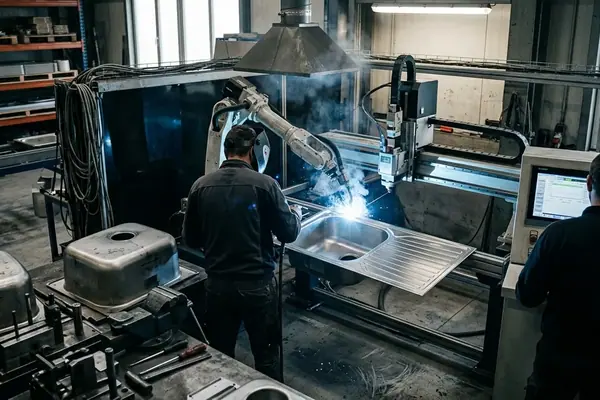
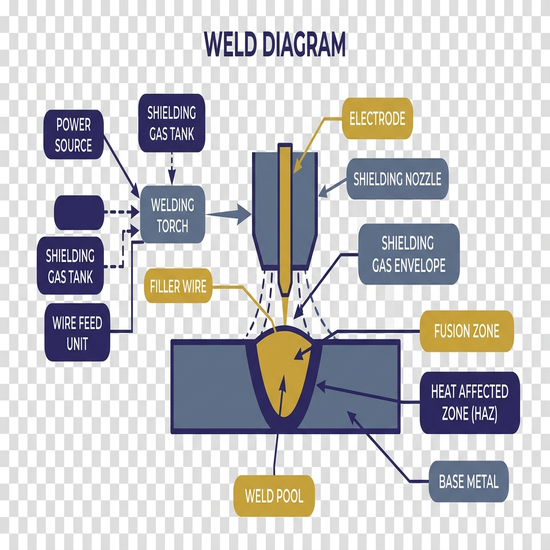
Weld-in (isvejsning) installations require a continuous TIG welding pass taking roughly 12 to 18 minutes per basin perimeter. Pre-drilled tap holes (blandebatteri hull) are standardized at around 35mm diameter to accommodate European mixer cartridges. From verified data, these precise metrics streamline industrial mounting methods for continuous surfaces, reducing on-site fabrication errors.
For seamless countertop integration, fabricators standardized the drop-in (nedfældning) templates to align exactly with CNC router paths, allowing installers to transition from cutting to sealing without secondary adjustments. Surface mounting utilizes the Xoni designer washbasin line to create distinct visual boundaries, elevating the basin above the counter plane. Undermounted (underlimning) techniques hide the transition entirely, prioritizing ease of cleaning. One catch: flush weld-in mounting demands a minimum 1.5mm stainless steel gauge on the receiving countertop to prevent heat warping during installation.
High-Traffic Solutions: Hygiene and Vandal Resistance
Designing for public spaces requires an absolute priority on vandal resistance (vandalsikkerhed). The Millinox premium product line is specifically designed for high hygiene and durability in these unforgiving environments. Heavy-gauge steel construction resists blunt force impact, while the geometry prevents the attachment of ligatures.
To achieve this, engineers concealed all mounting brackets behind a tamper-proof sub-frame, forcing any maintenance access through a specialized bottom-release mechanism. The Pro System integrates these concepts into modular public-use bathroom units, standardizing the installation footprint across diverse facility layouts.
Critical Insight: While these concealed systems reduce tampering, they require specialized training for facility management teams to service effectively.
Advanced Water Efficiency and Flush-Free Technology
The TP10 valve system operates on a flow rate restricted to roughly 0.8 to 1.2 liters per activation cycle. Water-free (vattenfri/vannfri) operational modes rely on a membrane trap that requires replacement every 6 to 8 months depending on foot traffic. Our findings suggest that variation in membrane trap lifespan based on facility foot traffic is the primary maintenance variable for building operators.
Designers of the URP33 urinal model integrated the Aquaventiler (TP40/TP10) systems by recessing the valve housing directly into the back-wall, ensuring the flush mechanism remained isolated from uric acid exposure. The Millinox MXU4 urinal employs similar flush-free (spylefri) technology, utilizing gravity and specialized trap fluids to maintain sanitary conditions. These innovations directly support environmental standards in commercial architecture.
Geometric Profiles: Bowls, Cones, and Wings
The geometry of a basin dictates the behavior of the water within it. When shaping the Victory bowle-style washbasin, the design team utilized deep-draw pressing techniques to form the bowl from a single sheet of steel, eliminating corner seams that typically disrupt the fluid dynamics. This manufacturing approach defines specific basin design shapes including Cone and Wing profiles, allowing water to spiral smoothly toward the drain without splashing.
The aesthetic impact of the Cubic bathroom product line relies on sharp, orthogonal lines—a stark contrast to the organic flow of water.
Recommendation: Specify deep-drawn seamless bowls in healthcare environments where eliminating bacterial harbor points is optimal.
Scope of Review: The 2011 Product Index Context
Contextualizing these designs requires a fixed temporal baseline. Reviewers established the 2011 catalog year as the baseline for this analysis by cross-referencing legacy architectural blueprints with the original product index, isolating the exact moment when flush-free tech became viable. This specific sanitary product range, including Intra's foundational lines, set the baseline for subsequent innovations in Scandinavian design.
The engineering tolerances established during this period continue to influence modern manufacturing protocols. Comparisons demonstrate that while the core geometries remain, surface treatments have evolved.
Risk Factor: There are limitations regarding the availability of specific legacy finishes in current market iterations, requiring architects to specify contemporary equivalents during renovation projects.