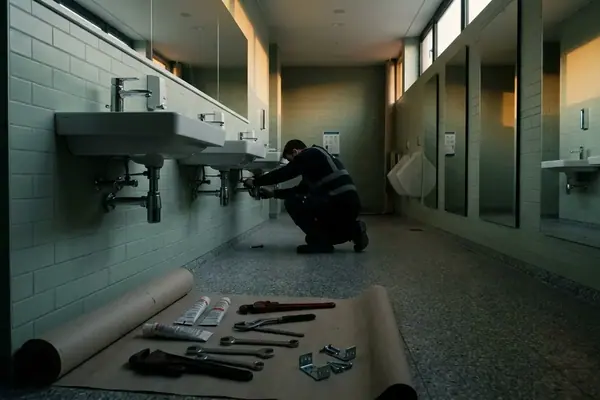
High-traffic washrooms punish weak specifications. Door hardware, basins, urinals, panels, and waste points all sit inside a cycle of moisture, impact, chemical cleaning, and hurried public use. In that setting, a sanitary fixture is not a decorative object. It is a small piece of architecture that has to keep working after the drawing set has been archived.
What's Inside
- The demands of modern architectural sanitary design
- 18/10 stainless steel as the material base
- Brushed and high polish Endura finish behavior
- Vandal resistance, coatings, and custom specification
- Recessed and welded-in installation methods
- URP33 water-free urinal performance logic
- Limits of halogen-resistant coatings
- Final verdict for specifiers
The Demands of Modern Architectural Sanitary Design
The serious decisions happen before the washroom looks finished. Architects increasingly establish lifecycle priorities during the first drafting phase, not after the fixture schedule has been priced. That shift matters because public facilities rarely fail in one dramatic event. They fail through replacement cycles, loose fixings, staining, chemical dulling, and visible wear that makes a clean room feel neglected.
From aesthetic-first to material-first specification
Intra sits in the Scandinavian sanitary tradition where restraint is not the same as fragility. The useful question is not whether a fixture appears refined on day one. It is whether the material, finish, and mounting method can hold the architectural intent under constant use.
That is where Endura finishes earn attention. They are not cosmetic afterthoughts applied to a weak substrate. Their performance depends on the steel below, the surface treatment above, and the way the fixture transfers load back into the wall or frame.
Critical Insight: In high-traffic sanitary design, finish selection should follow the maintenance model. If cleaning crews use aggressive chemicals, public users create impact risk, and lighting exposes every scratch, the fixture schedule has to solve those conditions together.
Material Science: The Foundation of 18/10 Stainless Steel
18/10 stainless steel is the quiet engine of the specification. The alloy composition is maintained at around 18% chromium and 10% nickel, a balance selected for oxidation resistance and ductility before the sheet is shaped into commercial fixtures.
Why chromium and nickel both matter
Chromium supports the formation of a protective chromium oxide layer at the surface. That layer is central to stainless steel behavior in wet, cleaned environments. Nickel contributes to ductility, which matters when the material goes through heavy-duty commercial stamping instead of remaining a flat architectural panel.
Metallurgical engineers balance those two priorities carefully. Push the material only toward corrosion resistance and it may not form cleanly under demanding geometry. Push it only toward formability and the washroom environment starts to win too early.
For Millinox stainless steel products, the practical range is also physical: heavy-duty commercial stamping uses sheet thicknesses of roughly 1.5mm to 2.0mm. That thickness gives the fixture enough body to resist deformation while still allowing accurate forming. It is the sort of number that belongs in the specification notes, not in a sales brochure.
Recommendation: Treat 18/10 stainless steel as the baseline material requirement for premium public sanitary fixtures when corrosion resistance, stamping integrity, and service life all carry equal weight.
Aesthetic and Functional Finishes: Brushed vs. High Polish
Comparisons demonstrate a simple divide: brushed finishes forgive use; high polish exposes it. Both have architectural value, but they behave very differently once traffic, cleaning, and lighting enter the room.
Brushed finish: controlled diffusion
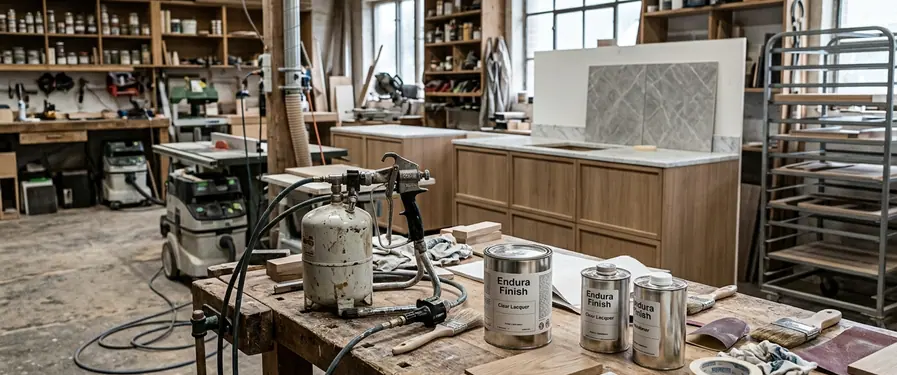
The brushed Endura surface uses mechanical brushing with roughly 180-grit to 240-grit abrasive belts. That process creates a directional grain that scatters light instead of reflecting it as a sharp image. Micro-abrasions still occur in busy washrooms, but the grain hides many of them because new marks visually merge with the existing surface direction.
This is not magic. Scratch visibility still varies with directional lighting and abrasive grit finish. A strong grazing light from a corridor can reveal marks that overhead lighting softens. Even so, brushed stainless is usually the calmer choice for transit stations, schools, stadiums, and any washroom where the maintenance team needs predictable visual aging.
High polish: architectural clarity with maintenance cost
High polish takes the opposite path. Multi-stage buffing produces a specular surface with high reflectivity. It can look precise and almost monolithic in a premium interior, especially beside stone, glass, or dark wall panels.
But the surface asks for discipline. Fingerprints, wipe marks, and fine scratches read quickly because the finish reflects light in a cleaner, sharper way. High polish is a design decision with a maintenance obligation attached.
Finish Comparison: Brushed vs. High Polish| Finish Type | Micro-Abrasion Masking | Light Reflectivity | Maintenance Frequency |
|---|---|---|---|
| Brushed (180-240 Grit) | High | Diffused/Low | Low to Moderate |
| High Polish | Low | Specular/High | High |
Engineering for Vandal Resistance and High-Traffic Durability
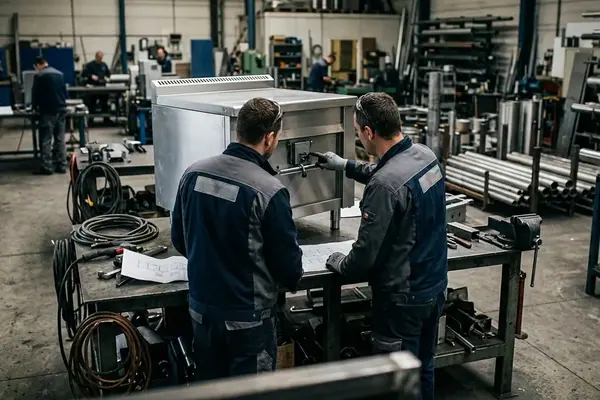
Vandal resistance starts behind the visible face. Designers map high-frequency impact zones on standard fixtures, then reinforce the rear cavities with welded gussets so blunt force does not turn a clean face into a dented membrane.
Impact zones and internal geometry
The Endura vandal-resistant line uses TIG welded internal gussets positioned at roughly 45-degree angles behind primary impact zones. The angle matters because the reinforcement does not simply add mass. It redirects force into the surrounding body of the fixture and reduces the chance of local deformation.
That is the difference between heavy and durable. Heavy parts can still flex in the wrong place. Reinforced parts have a load path.
Coatings and chemical resistance
Halogen-resistant coatings address another kind of attack: harsh cleaning chemistry. Public washrooms often rely on strong disinfectants, and the wrong finish can dull, pit, or discolor when cleaning routines intensify. The coating strategy aims to slow that chemical degradation while preserving the stainless substrate beneath.
Custom specifications matter here. A nightclub washroom, a hospital public zone, and a coastal sports facility do not share the same abuse profile. Client-specific manufacturing services allow reinforcements, fixture geometry, and finish selection to align with the actual risk rather than an average condition on paper.
Risk Factor: A vandal-resistant fixture still needs the correct wall condition and fixing method. Reinforcement inside the product cannot compensate for a weak substrate behind it.
Integration and Installation: Recessed and Welding In Techniques
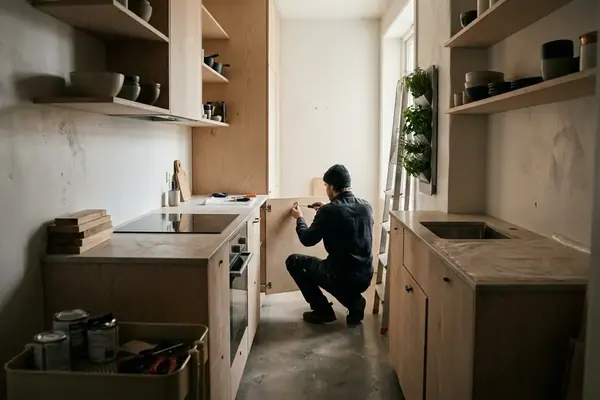
The cleanest washroom details often come from the least visible installation choices. Recessed fixtures reduce protrusions, protect edges, and make the product feel integrated into the wall plane rather than attached after the fact.

Recessed installation as architectural protection
Recessing changes the risk profile. Exposed lips and surface-mounted corners invite leverage, moisture collection, and impact concentration. A recessed installation shelters those vulnerable transitions and gives cleaning crews simpler edges to wipe.
The blueprint needs to show this early. Wall build-up, service access, waterproofing, and tolerance all affect the final result. If the recessed condition appears late, the contractor may treat it as a field improvisation. That rarely ends well.
Why welded-in fixtures outperform adhesive mounting
Engineering teams mandate recessed and welded-in techniques for high-security environments. The design team initially considered heavy-duty industrial epoxy for surface mounting, but rejected the approach after thermal cycling concerns. Failure of surface-mounted epoxy adhesives under thermal cycling in high-traffic washrooms is not a theoretical annoyance; it creates gaps, movement, and tamper points.
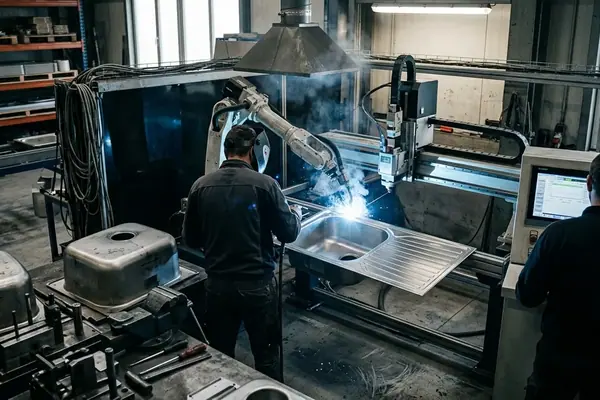
The stronger method uses continuous seam welding with 316L filler rod. Thermal cycling tests ran over a simulated period of roughly three to four years, giving specifiers a clearer basis for demanding welded details where moisture ingress and tampering carry real consequences.
Recommendation: Specify recessed and welded-in sanitary fixtures directly in the commercial blueprint notes, including access requirements and welding expectations. Do not leave the mounting method to post-tender negotiation.
Advancing Water Conservation: The URP33 Urinal
The URP33 water-free urinal shows how fixture engineering can reduce operational water demand without adding visual complexity. Its performance begins with geometry. Fluid dynamics modeling dictates the internal bowl slope, using gravity-fed evacuation instead of a traditional water flush cascade.
Gravity-fed form and Endura hygiene
The bowl pitch is engineered at roughly a 12 to 15-degree downward slope. That range supports fluid movement toward the outlet while keeping the fixture form suitable for public use. The Endura finish then has to support hygiene through cleanability, chemical tolerance, and resistance to visible degradation.
Water-free systems also change the maintenance conversation. Facilities reduce flush-water dependency, but they must follow the correct servicing routine for cartridges, traps, or system-specific components. The fixture is not maintenance-free. It is a different maintenance model.
For public-sector and commercial teams evaluating waterless systems, the U.S. Department of Energy provides water-efficient technology guidelines that help frame operational considerations beyond the product itself.
Critical Insight: The best waterless specification pairs bowl geometry, finish durability, and service access. Remove any one of those three, and the environmental benefit becomes harder to protect in daily operation.
Scope and Limitations of Halogen-Resistant Coatings
Evaluations reveal the coating story in sharper terms when the exposure gets severe. Testing protocols for halogen-resistant coatings involve exposing sample panels to concentrated industrial bleach and monitoring the surface for micro-pitting over extended intervals. Provided context includes sodium hypochlorite concentrations exceeding around 12%, which sits well beyond ordinary light-duty cleaning conditions.
What the coating can and cannot absorb
The coating is useful, but it is not a license for careless maintenance. One catch: the halogen-resistant coating degrades rapidly if wire brushes or scouring pads abrade the surface before chemical exposure. That mechanical abrasion strips the protective passivation layer, leaving the stainless surface more vulnerable when chemistry arrives next.
This assessment treats coating performance as a combined result of chemical exposure, cleaning sequence, surface condition, and fixture environment. In other words, the conclusion belongs to this use case: public sanitary fixtures exposed to strong cleaning regimes, not open-ended industrial chemical immersion.
High polish caveat
High polish finishes need special caution. Abrasive tools do not merely clean them; they rewrite the surface. Once that happens, maintenance staff cannot easily restore the original reflectivity without a controlled refinishing process.
Lifespan expectations therefore depend on environment. Coastal air, cleaning chemistry, user behavior, ventilation, and lighting all influence how long a fixture looks aligned with the original architectural intent.
Risk Factor: Do not specify high polish in a harsh cleaning environment unless the facility team accepts the required maintenance frequency and tool restrictions.
Final Verdict on Intra's Endura Line
Endura makes the strongest case when architects evaluate the fixture as a system: 18/10 stainless steel, finish texture, vandal-resistant reinforcement, coating behavior, and installation method. No single layer carries the whole result.
Where the value sits
The upfront capital expenditure will usually sit higher than a basic sanitary fixture package. Specifiers know this. The more relevant comparison is the projected reduction in maintenance interventions, replacements, visual decline, and site disruption over the operating life of the facility.
For interior designers, the appeal is also visual. Scandinavian restraint works well in public washrooms because it does not depend on fragile ornament. Brushed Endura surfaces, recessed planes, and clean welded transitions can feel architectural without becoming precious.
For architects, the decision is more direct. If the washroom faces heavy traffic, aggressive cleaning, or vandal risk, the specification should start with material physics. Amara Diallo's field rule applies cleanly here: strip the product back to physical laws before adding a single feature.
That is the Endura argument in plain terms. It balances refined sanitary design with rugged functionality, and it gives the drawing set enough technical substance to survive the building's daily use.