The Molecular Advantage of Physical Vapor Deposition
The assumption that premium architectural finishes require delicate care is obsolete. Physical vapor deposition changes the surface architecture of a fixture so it can withstand the abrasion built into daily kitchen and bathroom use.
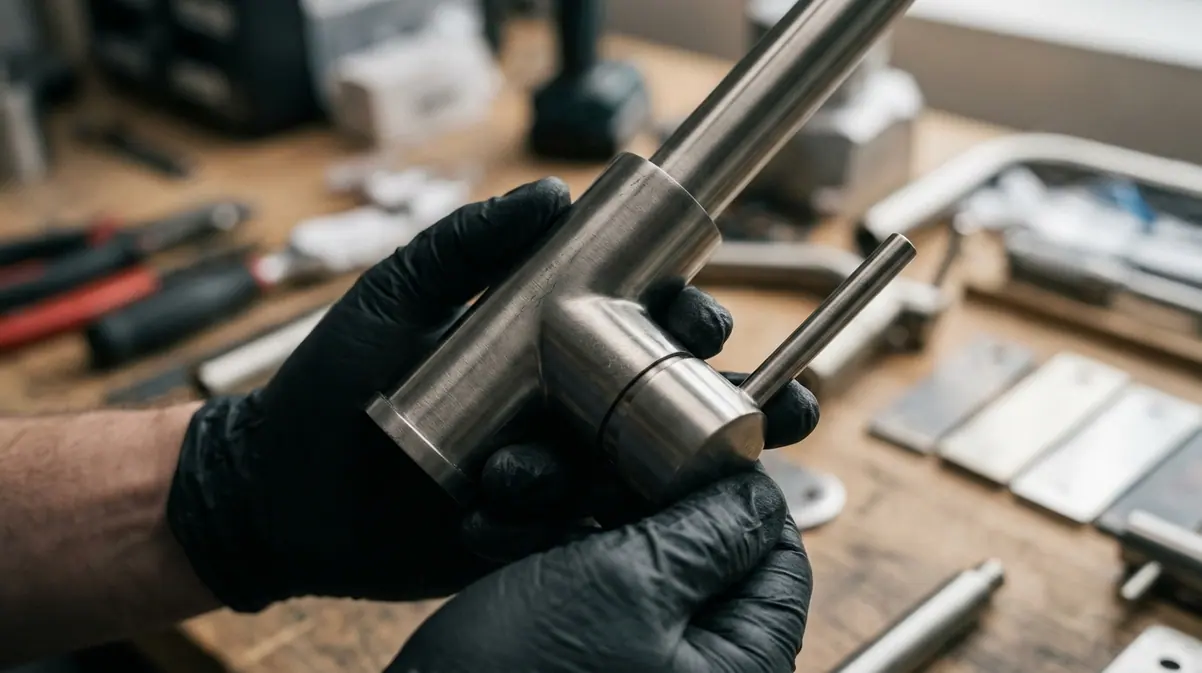
Traditional coatings sit on top of a prepared component. PVD takes a different route. Inside a vacuum chamber, a source material such as titanium or zirconium becomes vapor and deposits onto the fixture. The resulting layer bonds at the atomic level rather than behaving like a conventional decorative film.
The hardness benchmark explains why that distinction matters. Titanium nitride applied through PVD reaches approximately 2500 to 2700 HV on the Vickers scale. Standard chrome plating sits around 400 to 600 HV. Hardness alone does not describe every aspect of service life, but it provides a useful measure of resistance to scratches, deformation and repeated contact.
That performance suits the modern Scandinavian interior. Minimal rooms expose every junction, reflection and blemish. A tap beside a pale stone worktop must hold its visual line while enduring cookware, rings, cleaning cloths and mineral deposits. Designers increasingly specify atomic-level bonding because the finish supports the same disciplined balance of form and function as the surrounding architecture.
Hardness in Context
PVD improves the working surface of a fixture. It cannot conceal weak machining, soft edges or poor polishing underneath. Substrate quality remains part of the specification.
Navigating the Spectrum of PVD Color Profiles
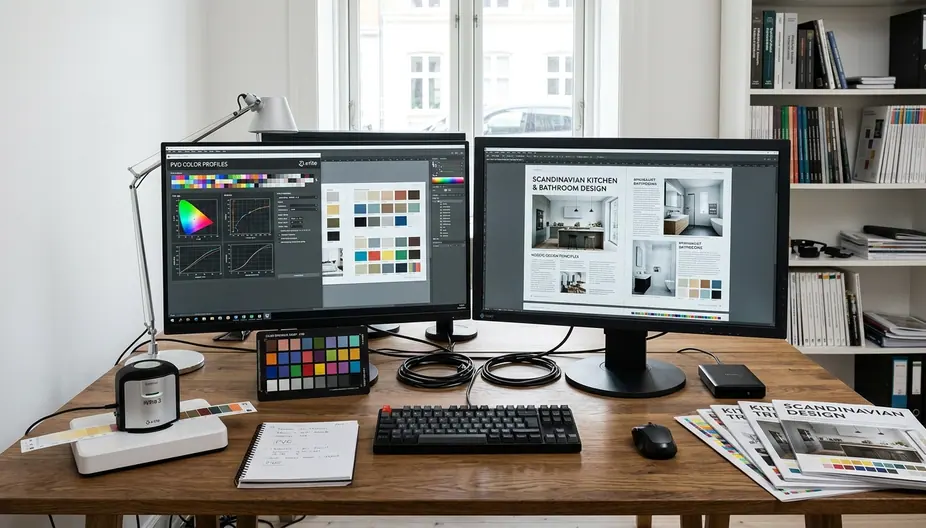
Brushed brass, gunmetal, architectural black and warmer metallic tones can emerge from the same broad deposition method. The final color depends on the target material, reactive gases, chamber conditions and the texture prepared on the base metal.
For a multi-fixture kitchen island, batch matching carries more weight than the appeal of a single showroom sample. Standard electroplating presents a greater risk of oxidation-induced color drift across production runs. PVD gives the manufacturer tighter control over the deposition recipe. Nitrogen flow adjustments of roughly 12 to 18 standard cubic centimeters per minute can move the resulting profile from pale brass toward deep gunmetal.
This control supports absolute color stability only when the factory records and repeats the full recipe, including substrate preparation and chamber conditions. A finish name by itself offers too little information. The specification should identify the approved sample, base material, brushing direction and batch-control process.
Color Changes Under Architectural Light
Metallic color remains responsive to its setting. A brushed gunmetal PVD finish can read as cool grey beneath 4000K overhead LEDs, then shift toward warm bronze under 2700K illumination. The metal has not changed; the spectral balance of the light alters which reflections dominate.
That interaction gives PVD its visual depth. Light catches the linear grain, darker tones settle between the brush marks, and the fixture retains a distinctly metallic character. Flat black powder coating absorbs more of that variation, producing a quieter and more graphic silhouette.
Sample Under Light
Review the approved finish beside the actual stone, timber and lighting temperature. A portable sample viewed under generic showroom lamps cannot settle a color decision for a completed room.
Durability and the Reality of High-Use Environments
A kitchen fixture rarely encounters one dramatic impact. Its service life accumulates through small events: a saucepan rim clips the spout, a steel colander rests against the mixer body, and a ring crosses the handle several times each day. Atomic-bonded finishes resist this mechanical wear better than topical color layers because the hard deposited surface adheres closely to the prepared substrate.
Bathrooms create a different test. Persistent humidity, grooming tools and repeated wiping expose weaknesses around edges and control interfaces. Powder-coated fixtures can perform well when their coating remains intact, yet a chip may give moisture a path beneath the film. PVD avoids the same film-like failure pattern and generally preserves crisp edges more effectively in high-moisture rooms.
Chemistry sets the practical boundary. PVD withstands severe mechanical abrasion from daily cookware impacts, while industrial descalers containing hydrofluoric acid or high concentrations of hydrochloric acid can rapidly degrade its structural integrity. This qualifier matters in commercial kitchens and heavily serviced residential properties, where maintenance staff may reach for concentrated products designed for tile, drains or industrial equipment.
Impact resistance also depends on what lies below the finish. Micro-pitting can occur when PVD is deposited over improperly polished brass. As the fixture expands and contracts with temperature, contamination or cavities interrupt the bond and create local failure points. A premium surface therefore begins with machining and polishing standards, not with the final color selection.
Descaler Boundary
Keep industrial acid descalers away from PVD fixtures, even when the product works safely on nearby ceramic or masonry. Separate application tools and clearly label approved cleaning products.
Maintenance Protocols for Preserving Surface Integrity
The effective maintenance routine is short: remove loose grit, wash with mild soap and water, rinse, then dry with a clean soft cloth. Frequency matters more than force. Regular removal of soap residue and mineral droplets prevents deposits from becoming stubborn enough to invite aggressive scrubbing.
Cleaning solutions should remain within a pH range of around 6.5 to 8.0. Mild surfactants loosen oils and suspended dirt without attacking the deposited layer or disturbing protective chemistry on exposed stainless components. Chromium oxide, the passive film associated with stainless steel, also benefits from cleaning methods that avoid harsh acids and unnecessary abrasion.
PVD Fixture Specification & Maintenance Checklist
- Verify that the base metal receives multi-stage ultrasonic cleaning before deposition.
- Confirm the color-tuning gas-flow metrics used for fixtures produced across separate batches.
- Approve a physical finish sample with its brushing direction clearly marked.
- Check every routine cleaner for a pH between 6.5 and 8.0.
- Remove abrasive pads, metal scourers and gritty cleaning powders from the maintenance kit.
- Use separate cloths for acidic descalers applied to adjacent surfaces.
- Rinse soap residue and dry the fixture to limit visible mineral spotting.
Abrasive pads create a more subtle problem than an obvious scratch. Their fibers cut across the microscopic grain and alter the surface texture unevenly. Repeated scrubbing can compromise the intended microscopic surface tension and change how water, oils and light behave across the finish. On brushed brass, the damaged patch may appear brighter from one angle and darker from another.
Commercial degreasers deserve equal scrutiny. A product marketed for general kitchen use may contain alkaline builders, acids or abrasive particles suited to floors and stainless worktables. The label category says little about compatibility with a thin architectural finish. Maintenance teams should control the exact product rather than relying on broad terms such as “non-scratch.”
Preserve the Grain
Wipe in the direction of the brushed texture with a soft cloth. This limits cross-grain marks and keeps reflected light consistent along handles, spouts and escutcheons.
The Vacuum Chamber Reality: Atomic Bonding in Fixture Design
The finish earns its quality before deposition begins. Machining residue, polishing compound, fingerprints and microscopic particles can block intimate contact between vapor and substrate. Premium production therefore uses a multi-stage ultrasonic cleaning sequence to remove contaminants from recesses that ordinary wiping cannot reach.
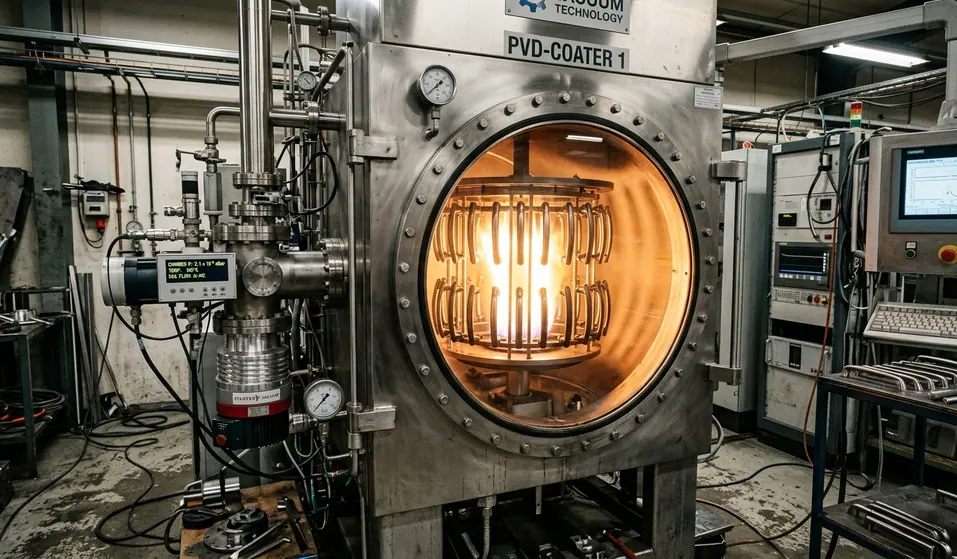
After cleaning, the fixture enters a controlled vacuum chamber. Operating pressure falls between 10-4 and 10-6 millibar. Under those conditions, vaporized atoms travel with far fewer collisions from airborne molecules, allowing the process to build a dense, controlled layer across the prepared component.
Preparation Determines the Finish
A chamber cannot repair a poorly polished brass body. Scratches remain legible beneath reflective finishes, sharp transitions may receive uneven coverage, and embedded compound can seed adhesion defects. The strongest specification documents base-metal preparation alongside color, sheen and coating method.
Active deposition typically lasts 45 to 120 minutes depending on the required coating thickness. During that interval, gas flow and source material shape the color while the vaporized titanium or zirconium bonds to the fixture. The process turns decoration into material engineering.
At those chamber pressures, a deposition cycle of an hour or two leaves the fixture with a surface measurably harder than the brass beneath it — the color and the metallurgy are the same layer.