
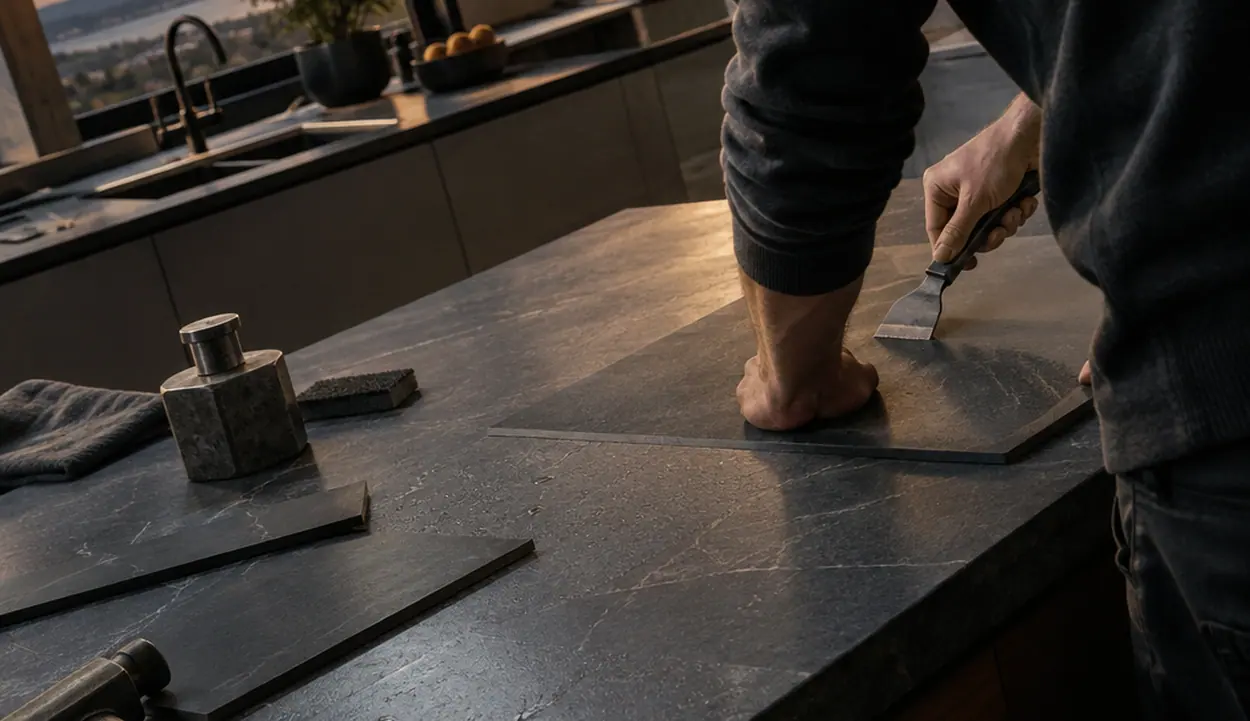
Acrylic Resin Architecture and Low-Light Reflectivity
FENIX NTM (NanoTech Matt) is an interior surfacing material produced by Arpa Industriale. Rather than relying on conventional varnishes or standard melamine overlays, the manufacturer coats a decorative paper core with next-generation acrylic resins and hardens the exterior via an electron beam curing process. Thermosetting resins compose roughly 60% of the decorative paper core weight, while the outer multilayer acrylic coating accounts for the remaining 30% to 40%. This manufacturing sequence yields a dense, non-porous surface engineered for both vertical cabinetry and horizontal prep zones.
At the microscopic level, the hardened resin forms a tightly packed topography of nanoparticles. These microscopic hills and valleys create an uneven landscape at the nanometer scale. When incoming light strikes the panel, the uneven peaks scatter photons across multiple vectors rather than bouncing them back at a direct specular angle. The surface has a specular gloss reading in the neighborhood of 1.5 to 3 Gloss Units (GU) when measured at a 60-degree incidence angle.
In northern architectural design, expansive floor-to-ceiling kitchen glazing invites low-angle daylight deep into the floor plan. When winter solar angles drop to somewhere around 12 to 15 degrees, standard satin or UV-cured matte polyurethane lacquered doors often suffer from severe specular glare, turning dark millwork into reflective mirrors that highlight every smudge. I observed residential cabinetry installations to see how these low-gloss acrylic panels handle daily skin oils compared to traditional painted joinery. Because the nanometer-scale valleys prevent sebaceous finger oils from forming a continuous film, the panels resist fingerprint transfer and maintain an absorbent visual depth even under harsh grazing sunlight.
Evaluating Abrasion, Impact, and Dry Heat Under EN 438 Criteria
Under EN 438 standard specifications for high-pressure decorative laminates, panels undergo rigorous mechanical stress benchmarking for surface wear, small-diameter ball impact, and dry heat exposure. Bench tests verify a dry heat tolerance rated under EN 438-2 up to 180 degrees Celsius for a 20-minute exposure window without blistering or gloss variation. On 12 mm self-supporting compact panels, small-diameter ball impact resistance exceeds 20 Newtons.
Under 3000K linear under-cabinet LED strips mounted 450 mm above the worktop, the electron-beam cured surface generally resists the routine sliding of unglazed ceramic tableware and brief contact with hot saucepans. However, kitchen planners must respect strict physical thresholds. Pulling a cast-iron skillet directly off an induction hob transfers localized thermal energy well beyond the 180-degree threshold, which will blister and permanently delaminate the resin. Similarly, slicing food directly on the counter with serrated steel blades where the hardened chromium oxide passive film meets the polymer will breach the acrylic topcoat.
Thin Sheets Versus Solid-Core Compact Panels
Selecting the right panel thickness dictates how a kitchen handles moisture and point-load stress. Fabricators assess thin sheets pressed onto particleboard and solid-core compact panels for their resistance to standing water around sink cutouts and point-load impacts. A breakdown of the 0.9 mm vertical sheet versus 12 mm solid-core compact phenolic panel under EN 438-2 180-degree-Celsius dry heat and small-ball impact criteria clarifies where each material belongs:
- 0.9 mm Thin Sheet: Designed for vertical cabinet doors, appliance panels, and drawer fronts, or low-moisture horizontal runs when cold-pressed onto an 18 mm MDF or multi-ply birch plywood substrate. The substrate absorbs impact energy, making core stability dependent on edge sealing.
- 12 mm Solid-Core Compact Panel: Composed of layers of phenolic-impregnated kraft paper fused into a self-supporting slab. Impervious to standing water, it supports flush-mounted or undermounted sink cutouts and cantilevered breakfast bars without secondary substrate backing.
The Thermal Repair Mechanism and Melamine Sponge Protocols
Superficial micro-scratches on nanolaminate rarely sever the crosslinked polymer chains; instead, mechanical friction pushes and displaces the microscopic hills into the adjacent valleys. This physical deformation alters local light refraction, making the mark visible as a faint shiny streak. Applying localized heat and moisture transfers kinetic energy into the dense acrylic network, allowing the displaced polymers to relax back into their original electron-beam cured memory state.
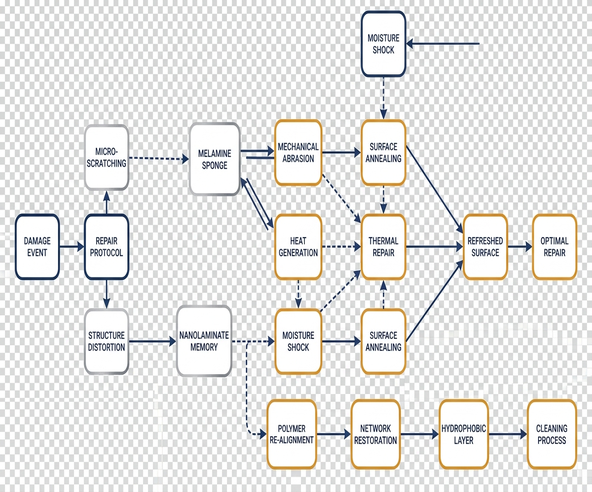
Both dry friction buffing and localized wet heat application can restore surface uniformity without leaving a burnished halo on dark matte doors. For daily maintenance and surface recovery, follow these two remediation protocols:
- Wet Thermal Relaxation: Place a dampened cellulose cloth or paper towel directly over the marred zone. Pass a standard household iron heated between 110 and 140 degrees Celsius over the damp cloth in circular motions for 10 to 15 seconds, then rinse the area with warm water and wipe dry with a microfiber cloth.
- Dry Melamine Foam Buffing: For minor friction marks or surface sheen transfers from packaging or cookware, rub a dry melamine foam sponge lightly across the scratch until the polymer micro-topography resets.
Acrylic Topcoat Penetration Limits
An irreversible gouge boundary exists where blade penetration passes the 20-to-30-micron electron-beam cured acrylic resin layer into the kraft paper core beyond 140-degree-Celsius thermal ironing recovery. Once a sharp metal edge cuts into the underlying phenolic-impregnated kraft paper, thermal relaxation cannot bridge the severed gap. Additionally, daily chemical resistance holds stable within a pH range of 3 to 10, though strong alkaline degreasers or wax emulsions will clog the nanometer-scale topography over time.
Zero-Joint Edgebanding and Core Substrate Engineering
The transition between the face sheet and the panel edge represents the primary structural vulnerability in laminated kitchen joinery, particularly adjacent to integrated dishwashers, steam ovens, and undermount sinks. Joinery workshops initially bonded 0.9 mm laminate sheets using standard ethylene-vinyl acetate (EVA) hot-melt glue before abandoning that method due to steam delamination above integrated dishwashers. Traditional EVA glue lines leave a visible seam that absorbs ambient humidity, swells, and yellows within a few years of heavy kitchen use.
Modern architectural millwork resolves this failure point by shifting to reactive polyurethane and laser-activated co-extruded polymer tapes. Zero-joint laser and hot-air edgebanding systems fuse a 1 mm polypropylene or ABS functional layer at operating temperatures between 200 and 220 degrees Celsius. This creates a monolithic bond between the panel face and edge designed to withstand continuous steam venting cycles without peeling.
For projects favoring an exposed-core Scandinavian aesthetic over concealed edges, fabricators press thin nanolaminate sheets directly onto multi-ply Nordic birch or black-dyed wood fiber cores (such as Valchromat). When executing this detail, polyurethane reactive (PUR) cold-press substrate lamination requires a 48-to-72-hour moisture-curing window prior to CNC chamfer routing. Once cured, the exposed plywood or dyed fiber edge is milled to a sharp bevel and sealed with matte polyurethane varnish to block moisture ingress while celebrating the layered construction.
Specification Blueprint: A High-Traffic Kitchen Island and Wet Zone
To translate these material properties into a buildable tender package, the following specification details a combined high-traffic prep island and perimeter sink run. Pairing dark vertical cabinetry with a mid-tone horizontal worktop masks dry mineral rings and stoneware sliding marks around the primary prep basin while preserving a crisp, monolithic profile.
Step 1: Vertical Fronts and Dishwasher-Adjacent Doors
- Surface Material: 0.9 mm FENIX NTM sheet in a deep architectural shade (such as Nero Ingo).
- Core Substrate: Cold-pressed using PUR adhesive onto an 18 mm moisture-resistant MDF core (V313 grade), balanced on the reverse interior face with a 2 mm structural backing sheet to prevent panel bowing.
- Edge Execution: Colour-matched 1 mm ABS edgebanding applied via zero-joint laser fusion at 200 to 220 degrees Celsius across all four edges, providing a sealed barrier against dishwasher venting cycles.
Step 2: Horizontal Worktop and Undermount Sink Cutout
- Worktop Slab: 12 mm solid-core compact FENIX NTM panel in a mid-tone shade (such as Grigio Londra or Castor Ottawa) to minimize visual contrast against hard water deposits and dry flour during prep.
- Edge Profile: CNC-routed 45-degree chamfer milled to a depth of 8 mm along the perimeter, exposing the dense black phenolic core for a slender horizontal shadow line.
- Wet Zone Integration: Undermounted high-grade stainless steel basin secured to the underside of the 12 mm compact panel via mechanical inserts. Seal the cutout perimeter with neutral-cure alkoxy silicone and enforce a strict 24-to-36-hour curing window before commissioning the plumbing fixtures.