
The High Stakes of Specifying Recycled Polymers in Wet-Zone Joinery
Specifying untested recycled laminates in high-moisture, high-wear kitchen environments invites catastrophic field failure. When a polymer skin delaminates above an integrated dishwasher or a particleboard core swells behind a sink apron, the resulting warranty replacements erase project margins and destroy architectural credibility. Kitchen cabinetry occupies a brutal microclimate. Cabinetry fronts installed adjacent to dishwashers and ovens must withstand continuous ambient radiant temperatures of about 70°C to 85°C and localized humidity spikes during appliance venting cycles without edge-seam lifting.
We see the true engineering cost of overcoming these vulnerabilities in the KUNGSBACKA kitchen front project, a joint industrial development by IKEA, Stockholm design studio Form Us With Love, and Italian manufacturer 3B. Developing and validating the recycled surface laminate required an engineering cycle spanning initial polymer compounding through factory-gate durability sign-off. Material engineers evaluating post-consumer waste streams for wet-zone cabinetry had to establish strict failure thresholds before committing to full-scale tooling. Evaluating candidate polymers for steam-cycle and thermal-shock resistance meant prioritizing interfacial adhesion over raw recycled content volume to avoid systemic warranty claims.
The challenge lies in reconciling strict Scandinavian durability and aesthetic standards with the erratic physical properties of post-consumer municipal waste. While high-grade stainless steel relies on a self-healing chromium oxide passive film to resist corrosion in wet zones, polymer-wrapped wood composites depend entirely on the mechanical integrity of their extruded skin and the chemical permanence of their edge seals. Post-consumer plastics carry thermal histories, trace contaminants, and degraded molecular weights that fight against tight-radius wrapping. Making a recycled bottle perform like an architectural-grade finish for decades requires treating waste streams with the same metallurgical rigor applied to structural alloys.
Why Virgin Plastics and Standard Particleboard Forced a Supply Chain Shift
Standard mass-market kitchen doors rely on virgin polymer foils ranging from roughly 0.15 mm to 0.40 mm in thickness, fused to virgin timber particleboard pressed with urea-formaldehyde resins. Furthermore, the product brief mandated that the finished recycled-composite door survive a 25-year residential warranty lifecycle while matching the retail price bracket of baseline virgin-foil cabinetry.
Those material requirements reveal why incremental material tweaks fail at industrial scale. High-volume cabinetry consumes vast quantities of fossil-fuel-derived melamine or polyvinyl chloride (PVC) surfaces alongside freshly harvested softwood. When Form Us With Love received the brief to design a modular, price-accessible matte anthracite kitchen front that eliminated virgin oil-based plastics from the surface layer, cost parity acted as a hard boundary. If a sustainable specification carries a price premium, mass-market adoption stalls, leaving the baseline supply chain untouched.
When transitioning away from virgin fossil-fuel-based melamine and PVC foils, industrial designers aligned the surface reformulation with a simultaneous core redesign. Rather than specifying virgin softwood forestry outputs, the procurement team routed sawmill offcuts, chipped pallets, and post-industrial wood waste into the particleboard press line to ensure the substrate matched the ecological profile of the skin.
Scandinavian design philosophy treats longevity as the primary metric of sustainability. A low-carbon material that peels, stains, or warps within five years under normal use negates any embodied carbon savings achieved at the factory gate. Replacing a kitchen prematurely doubles the manufacturing, transport, and installation footprint. Consequently, shifting from virgin PVC and melamine to post-consumer polyethylene terephthalate (rPET) meant the recycled polymer had to match the chemical resistance, dimensional stability, and tactile refinement of virgin architectural surfaces from day one.
Inside 3B’s Extrusion Process: Turning Post-Consumer PET into Matte Foil
Transforming baled municipal bottle waste into a defect-free architectural foil requires aggressive intervention at the molecular level. At Italian supplier 3B, the production line starts with post-consumer PET bottles sorted for color consistency and washed to remove organic residues. Thermoforming a 40-by-80-centimeter cabinet front requires the culinary-grade recycled PET foil of approximately 25 equivalent 500-milliliter post-consumer bottles. However, raw bottle flake cannot simply be melted and calendered into furniture foil.
Standard mechanical pelletizing without solid-state polycondensation can leave the extruded sheet too brittle to wrap tightly around the 45-degree chamfered door edges without micro-cracking, as thermal reprocessing cleaves the polymer chains and lowers intrinsic viscosity. Each time PET melts, trace moisture triggers hydrolytic degradation, shortening the molecular chains. By subjecting the recycled pellets to solid-state polycondensation under vacuum at elevated temperatures below the melting point, 3B linked those cleaved chains back together. This step restored the intrinsic viscosity and tensile elongation needed to pull the heated foil tightly over sharp milled corners without stress-whitening or fracturing.
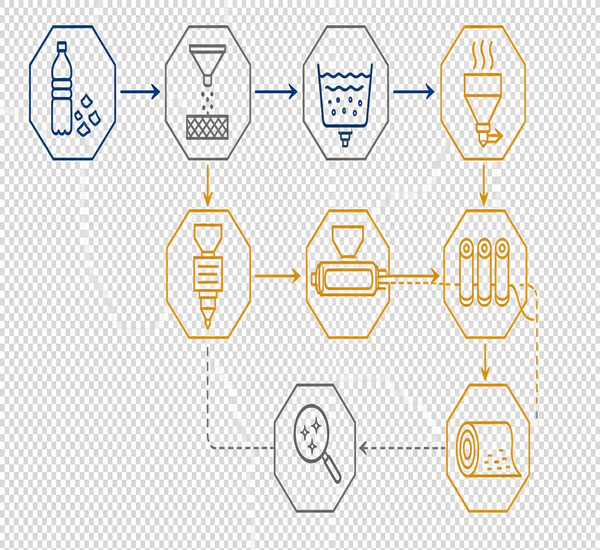
Contamination control presents an equally severe hurdle during flat-die sheet extrusion. Extrusion melt-filtration screens must capture non-melting contaminants down to 40 to 60 microns in most situations so stray aluminum cap fragments or label adhesives do not create surface nibs under a low-gloss matte topcoat. Once extruded, the sheet receives a functional coating that provides kitchen-grade scratch, chemical, and ultraviolet resistance. Low-reflectance matte polyurethane-acrylate topcoats are cured via excimer lamp arrays to achieve a 60-degree specular gloss reading below 5 Gloss Units (GU), masking substrate telegraphing while resisting household citric acid and ethanol staining. Excimer curing uses short-wavelength UV light in an oxygen-free nitrogen atmosphere to cause micro-folding of the topcoat surface, creating a dead-matte texture without loading the lacquer with weakening silica matting agents.
Pairing this engineered rPET foil with the reclaimed industrial wood core demands precise adhesive chemistry. Chipped pallets and sawmill offcuts produce a particleboard with higher surface porosity variations than virgin timber fiber. Ifthose micro-voids telegraph through the thin foil, the flat light reflectance of the door is ruined. The factory calibrates sanding tolerances on the reclaimed core before applying a reactive hot-melt adhesive system capable of bridging micro-irregularities while locking the thermoplastic skin in place against the steam blasts of modern kitchen appliances.
Chromium Oxide Deflector Mandate
While the engineered rPET laminate handles standard residential baking cycles, material physics sets a hard upper ceiling. Thermoformed recycled PET foils lose structural dimensional stability when exposed to direct, unshielded radiant heat above 85°C, restricting their installation around commercial-grade open-burner ranges without stainless steel heat deflectors. Specifiers placing recycled-polymer joinery beside high-output pro-style ranges must integrate brushed austenitic stainless steel strip shields—relying on their stable chromium oxide surface layer, to absorb and dissipate peak radiant spikes before heat reaches the polymer miter line.
The Circularity Trade-Off: Composite Bonding Versus End-of-Life Separation
Industrial sustainability rarely offers pure closed-loop solutions when durability is non-negotiable. Evaluating the KUNGSBACKA architecture from a first-principles lifecycle perspective exposes a fundamental tension between two design philosophies: designing for biological or technical disassembly versus designing for multi-decade composite permanence. In a disassembly-first model, skins are mechanically clipped or bonded with water-soluble glues so the plastic and wood can be separated at the end of the kitchen's life. In a wet-zone kitchen, that approach fails within months. Steam and cooking grease penetrate reversible joints, swelling the core.
3B and IKEA chose composite permanence. Cross-linked polyurethane reactive (PUR) hot-melt adhesives cure over a 48-to-72-hour window without special circumstances by reacting with ambient moisture in the reclaimed wood substrate, forming a thermoset bond that cannot be thermally reversed for end-of-life material separation. Once that moisture-cure reaction completes, the thermoplastic rPET foil and the lignocellulosic reclaimed wood core become an inseparable hybrid.
For architects auditing circularity metrics against European Environment Agency guidelines on circular plastics in construction, this compromise is critical. The door excels at waste diversion at the factory intake, pulling post-consumer bottles and industrial wood scrap out of the landfill and incineration streams. Yet at the end of its 25-year service life under normal use, the laminated board cannot be ground down and separated back into pure PET flake and clean wood fiber. It must enter energy-recovery incineration or downcycled composite filler streams. In high-humidity architectural joinery, extending the functional service life to a quarter-century via irreversible thermoset bonding yields a lower total lifecycle impact than building a separable door that delaminates in year four.
Aesthetic decisions on the production line followed the same pragmatic logic. Colorists and material scientists arrived at the deep matte anthracite specification after evaluating optical spectrophotometry readings across multiple batches of municipal bottle flake. Because trace green, blue, and amber pigments in post-consumer streams cause unpredictable yellowing in white or pale pastel extrusions, locking in a high-opacity dark carbon pigment allowed the factory to absorb seasonal feedstock shifts without batch-to-batch color drift. What reads in a showroom as quiet Nordic minimalism functions on the factory floor as an optical buffer against the visual noise of municipal recycling.
A Step-by-Step Specification Protocol for Recycled-Surface Millwork
Architectural specifiers adapting mass-produced recycled millwork for bespoke residential and multi-unit projects structured a three-stage pre-installation audit. By testing physical sample cut-outs under project-specific halogen and LED lighting arrays prior to tender approval, planners identify micro-scratch visibility and edge-seal vulnerabilities before cabinetry enters wet-zone installation. The protocol applies to the qualification of recycled-polymer cabinet fronts before installation.
Step 1: Verify Edge-Banding Radius and Adhesive Thermal Tolerance
Request two full-size sample doors from the current production batch rather than relying on small chain-sample swatches, which rarely reflect full-scale thermoforming tension along long stiles. Inspect the 45-degree chamfered edges under 10x magnification. Look specifically for micro-fissures or pale stress-whitening along the bend radius, which indicates insufficient solid-state polycondensation during pellet compounding.
Next, validate the thermal and moisture limits of the edge seam. Benchtop edge-seal verification requires exposing a sample door edge to a 60-minute steam impingement cycle at 90% relative humidity, followed by a 24-hour ambient recovery check with a feeler gauge about 0.05 millimeters thick at the chamfered miters. If the same blade slips beneath the foil lip at any point along the corner miter, reject the batch; the PUR adhesive coat weight was under-applied or cured prematurely before nip-roller pressing. Finally, check your elevation drawings to ensure a minimum 15-millimeter air gap or metallic heat-deflector strip installation between recycled-PET door edges and built-in oven cavities.
Step 2: Audit the Core-to-Surface Moisture Barrier and Back-Face Balancing
Flip the sample door over to examine the rear balancing sheet and the transition zone where the front thermoformed rPET foil meets the back face. A composite panel constructed from reclaimed wood particles expands and contracts in response to seasonal indoor humidity shifts. If the front face is sealed with a roughly 0.30-millimeter rPET foil wrapped over the edges, the rear face must carry a balancing laminate of equivalent vapor permeability and tensile modulus; otherwise, asymmetric moisture absorption will bow the door over an 80-centimeter vertical span.
Take your second sample door and make a clean cross-sectional saw cut directly through the center rail and chamfered edge. Inspect the core density directly beneath the 45-degree miter. Reclaimed wood cores often exhibit lower density in the middle layer and higher density at the faces. Verify that the milled chamfer does not expose porous middle-layer wood chips directly beneath the thin rPET wrap without sufficient resin filling. Seal all field-drilled hinge cups and handle penetrations during installation with silicone or polyurethane edge sealant so liquid spills cannot bypass the thermoformed skin and wick into the chipped-pallet core.
Step 3: Lock In the Post-Installation Optical and Maintenance Protocol

Before signing off on the tender package, place the uncut sample door vertically beneath the exact Kelvin-rated LED task lighting specified for the kitchen soffits and under-cabinet rails. Sight across the panel at a low grazing angle to confirm the excimer-cured topcoat holds a uniform reading below 5 GU without orange-peel texture or sub-surface contaminant nibs.
Once installed, the longevity of an excimer-cured recycled surface depends on the handover manual provided to the building owner or facility manager. For an ultra-matte anthracite kitchen front below 5 GU, the project O&M documentation specifies non-abrasive microfiber cloths and pH-neutral surfactants with a pH of 6.5 to 7.5 in most situations. Melamine foam erasers are excluded because they burnish the microscopic surface texture and leave permanent glossy patches: a cleaning method that removes a mark can permanently change the sheen of the door.