Sub-Arctic Growth Rings and the Mechanics of Culinary Wood
In high-latitude and sub-Arctic Norwegian forests, the brief 90-to-110-day summer growing window compresses annual growth rings to approximately 0.5 mm to 1.2 mm. This intense seasonal constraint yields exceptionally high-density timber straight from the sawmill. When placed alongside granite countertops and high-grade stainless steel sinks passivated with a protective chromium oxide layer, slow-grown Nordic hardwood functions as a permanent architectural fixture rather than a disposable countertop accessory.
Initially, I specified high-density synthetic polymer boards for residential sculleries, assuming non-porous plastics offered superior hygiene. After inspecting scarred polyethylene surfaces under magnification, I abandoned synthetics for primary prep zones. Knife blades slice permanent fissures into plastic that trap moisture and organic residue beyond the reach of detergent. In contrast, the microscopic cellular tracheids in diffuse-porous hardwoods generate capillary action that physically draws surface moisture inward. Bacteria are pulled below the cutting plane and desiccated inside the wood matrix where they cannot multiply.
To prevent warping once installed, kiln conditioning for interior culinary fixtures targets an equilibrium moisture content of 7% to 9%. This tight tolerance allows the timber to survive heated Scandinavian winter rooms where indoor relative humidity routinely drops to 20% to 30%. However, these structural and hygienic parameters hold true only for air-seasoned and kiln-dried Nordic hardwoods kept within normal residential indoor humidity levels; commercial dishwashing kitchens with constant steam exposure will overwhelm the timber's cellular moisture buffering.
Nordic Timber Selection: Birch, Beech, Oak, and Juniper
Norwegian Silver Birch (Betula pendula) registers a Janka hardness between 5,600 N and 6,000 N, while Pedunculate Oak (Quercus robur) contains earlywood vessels measuring 150 to 300 micrometers in diameter. For finer treenware, Common Juniper (Juniperus communis) requires 40 to 60 years in rocky alpine soil simply to reach a trunk diameter of 8 to 12 cm.
Millworkers use these anatomical metrics to match timber species to specific culinary contact forces, separating heavy chopping blocks from delicate dairy and porridge implements. Birch and European Beech (Fagus sylvatica) are close-grain, diffuse-porous hardwoods with microscopic vessels distributed evenly across both spring and summer growth. This uniform cellular architecture makes Silver Birch the benchmark for primary cutting surfaces: its 5,600 N to 6,000 N density resists deep fibrous gouging while buffering high-carbon steel knife edges tempered to 60–62 HRC without dulling the apex.
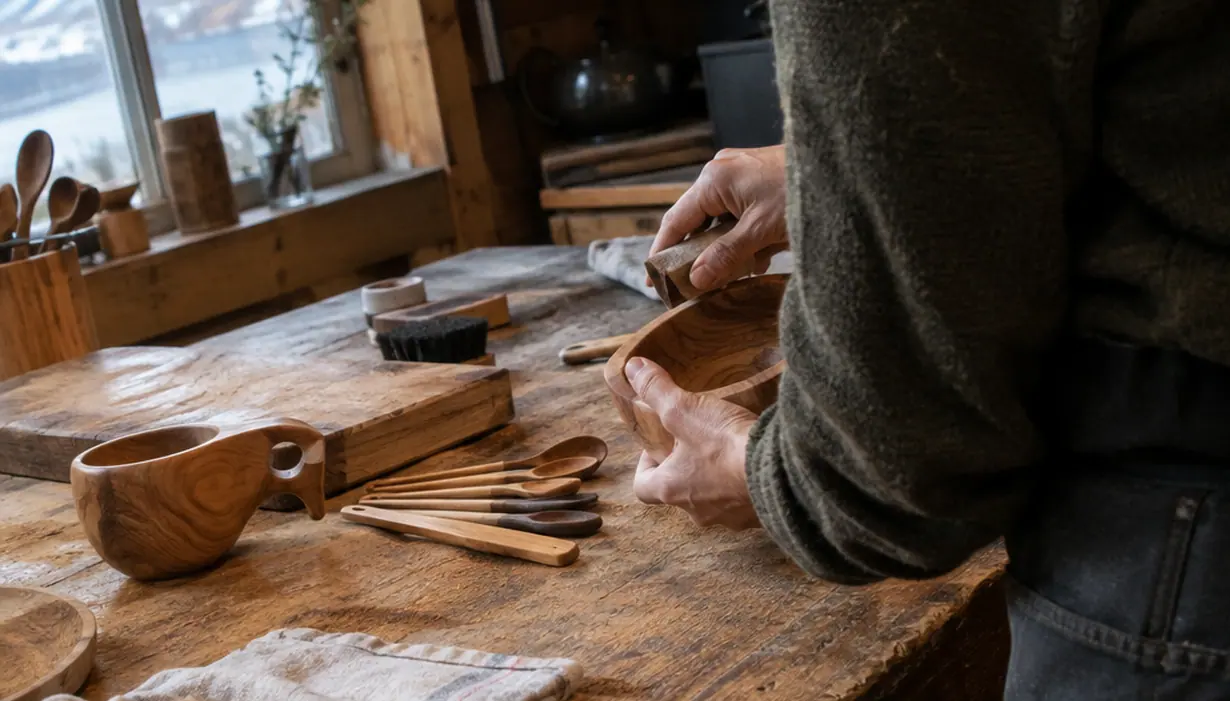
Distinguishing diffuse-porous Silver Birch from ring-porous Pedunculate Oak is critical during specification. Although oak heartwood contains natural antimicrobial tannins, its wide 150-to-300-micrometer earlywood vessels act as open trenches that trap food particles unless sealed with a heavy wax compound. Oak belongs on dry charcuterie presentation boards, whereas birch and beech handle wet butchery and vegetable prep. At the smaller end of the scale, the dense, aromatic stems of alpine juniper resist splitting when subjected to steep temperature shifts. Carvers reserve those 8 to 12 cm juniper billets for traditional smørkniver (butter knives) and tvuru (porridge whisks), where natural essential oils and tight grain prevent sour milk or hot grain starches from fouling the wood.
End-Grain vs. Edge-Grain Construction and Adhesive Standards
Integrating wooden worktops near wet zones requires choosing between vertical end-grain blocks, laminated edge-grain staves, and single-slab (heltre) boards. Cabinetmakers largely abandoned wide single-slab boards beside sinks and dishwashers because unrestrained tangential shrinkage across the growth rings pulls the timber into a severe cup when exposed to asymmetrical moisture. Instead, laminating narrow staves with alternating growth-ring orientations neutralizes internal warping forces before the billet ever reaches the planer.
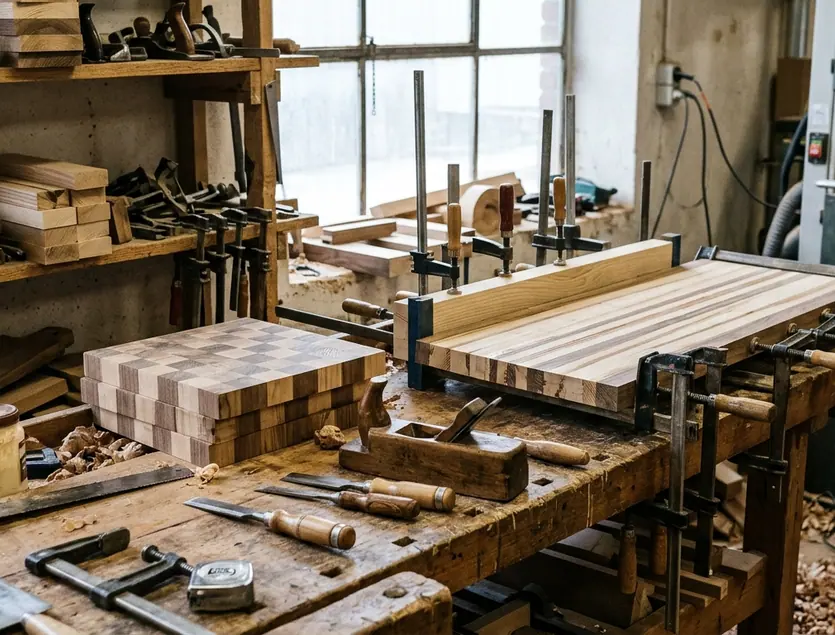
For heavy knife work, end-grain construction stands unmatched. Orienting the timber fibers vertically allows a sharp blade to part the cellulose bundles like bristles on a brush; once the knife lifts, the surrounding fibers spring back together, preserving both the board face and the steel edge. Because end-grain exposes open vascular bundles directly to the air, it absorbs and releases moisture rapidly. End-grain blocks require a substantial 45 mm to 60 mm thickness to resist internal shearing, along with balanced hydration on both top and bottom faces. Edge-grain boards, where horizontal fibers run parallel to the counter, demand less daily maintenance and shed water faster, provided the specification maintains a minimum thickness-to-width ratio of 1:10 (such as a 35 mm thickness for a 350 mm wide board).
Structural longevity in damp scullery zones depends equally on the glue line. Laminated boards intended for wet kitchen environments require adhesives meeting European standard EN 204 durability class D3 or D4, utilizing cross-linking polyvinyl acetate (PVAc) or moisture-curing polyurethane formulations. Every adhesive specified for culinary surfaces must carry proven food-contact clearance under EU Regulation 10/2011 to ensure zero monomer migration during chopping.
Food-Contact Suitability: Curing Oils, Waxes, and Regulatory Compliance
Under the Norwegian Food Safety Authority (Mattilsynet) regulations on food contact materials (Matkontaktforskriften), culinary timber finishes must never transfer toxic constituents to ingredients or alter food odor and taste. Meeting this statutory threshold requires separating polymerizing drying oils from inert surface barriers.
Traditional Nordic woodworkers favor cold-pressed raw linseed oil (rå linolje) pressed from flaxseed over petrochemical fluids. When warmed to 45°C to 55°C prior to application, raw linseed oil drops in viscosity and penetrates 2 mm to 4 mm deep into end-grain birch. Inside the wood pores, the oil reacts with atmospheric oxygen to form a tough, hydrophobic linoleic matrix. However, full cross-linking polymerization of unboiled raw linseed oil requires 21 to 28 days of oxygenated curing in a dust-free room before the timber can handle hot or acidic ingredients without leaching.
When a project schedule cannot accommodate a four-week curing window, pharmaceutical-grade mineral oil (parafinolje) provides an immediate, inert moisture barrier, though it never hardens and washes out rapidly under warm tap water. Regardless of the base oil, sealing the upper micron layer requires a hydrophobic wax paste. Traditional surface barrier topcoats are blended at a 4:1 weight ratio of liquid oil to unbleached beeswax (Cera alba) or carnauba wax, melted together in a water bath at 65°C to 70°C. Rubbed warm into Pedunculate Oak, this 4:1 compound packs the 150-to-300-micrometer earlywood vessels flush so food debris cannot lodge inside the grain.
Rancid Lipids and Metallic Driers
Never apply standard culinary dietary oils (olive, sunflower, or canola) to wooden kitchenware; their triglyceride structures oxidize imperfectly and turn rancid within the wood pores, ruining food flavor. Equally hazardous is hardware-store "boiled" linseed oil (kokt linolje), which contains toxic metallic drying agents (cobalt or manganese siccatives) strictly prohibited on food-contact surfaces.
Sourcing Husflid Craft and Executing a Surface Restoration Protocol
During studio visits to regional woodworking cooperatives, I learned to verify timber custody through certified Husflid (traditional craft) guilds. Working directly with small-scale Norwegian millworks guarantees that birch, oak, and alpine juniper billets originate from sustainable high-latitude forestry and undergo slow, stress-free kiln seasoning before joinery begins.
Once installed in a residence, wooden fixtures rely on disciplined daily care to rival the longevity of chromium oxide passivated steel sinks. Clean boards immediately after prep by hand-washing with warm water and a mild, pH-neutral soap. Stand the board vertically on its edge so air circulates equally across both faces, preventing uneven moisture gradients that bow the timber. To strip lingering onion or fish odors without harsh detergents, scrub the damp surface with coarse sea salt and half a lemon, let the mild acid sit for around five minutes, and rinse clean.
When years of knife contact leave deep scoring or raised, fuzzy grain, execute a structured mechanical resurfacing protocol:
- Diagnostic Bead Check: Place a 5 ml droplet of room-temperature water on the primary cutting zone and observe it for 120 seconds. Water readily soaking into the grain rather than beading can indicate that the finish needs replenishing.
- Coarse Leveling: Sand the dry board strictly along the grain using an 80-grit aluminum oxide abrasive until knife trenches disappear, then refine the scratch pattern with a 120-grit pass.
- Water-Popping the Fibers: Mist the bare wood evenly with distilled water and wait 15 to 20 minutes. The moisture swells and raises severed cellulose fibers above the surface plane.
- Final Shearing Pass: Sand the dried surface with a fresh 180-grit abrasive. Stopping abrasive resurfacing at 180-grit after water-popping ensures severed diffuse-porous birch fibers shear cleanly without burnishing the lignin and closing the pores against oil uptake (which occurs when sanding beyond 220-grit).
- Thermal Re-Saturation: Flood the freshly sheared grain with raw linseed oil warmed to 50°C, wipe away surface excess after 30 minutes, and seal with the 4:1 oil-to-beeswax paste once cured.
Run the 5 ml water-droplet check on your primary wooden cutting surface today: measure out one teaspoon of room-temperature water onto the center work zone and observe it for two minutes. If water readily soaks into the grain, renew the oil finish, allow it to cure, then apply the 4:1 beeswax-and-linseed compound warmed to 65°C.